Best Kitchen Materials for Coastal Homes on the Central Coast
March 13, 2026


Coastal homes face a unique mix of sunshine, salt air and shifting humidity that can quickly expose weaknesses in a kitchen. Finishes that look beautiful in a showroom may swell, peel or rust once they are exposed to coastal conditions. Central Coast Kitchens & Bathrooms sees how the right materials can keep a kitchen looking fresh and functioning smoothly for many years. In this article, explore which benchtops, cabinetry finishes, splashbacks, flooring and hardware stand up best to the local environment and daily family life.
You will discover how salt resistance, moisture stability and ease of cleaning should influence material choices along with style considerations that suit relaxed coastal living. Look at durable options for busy households; discuss which products cope well with sandy feet and open windows and highlight finishes that maintain their colour and texture in strong coastal light. By understanding how different materials perform, homeowners can invest in a kitchen that is beautiful and continues to add value and comfort long into the future.
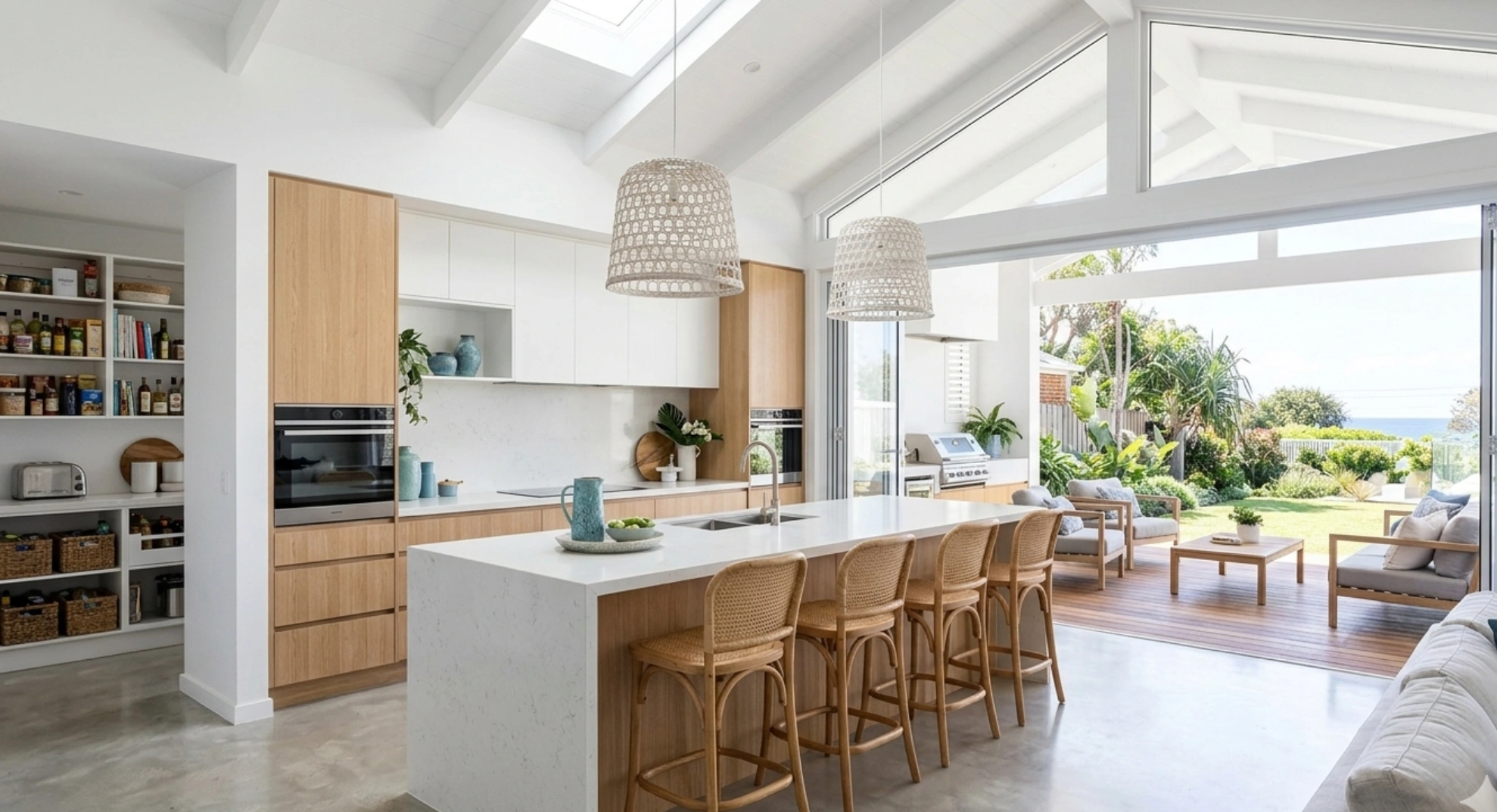
Kitchens in Central Coast homes face very different conditions from those in inland properties. Salt-laden air, higher humidity, strong sunlight and sandy traffic from the beach all put extra stress on benchtops, doors, hardware and appliances. Choosing the wrong materials can lead to swelling, rust, peeling finishes and a kitchen that looks tired far sooner than it should.
Designers design with these local conditions in mind. Understanding how the coastal environment affects different products helps homeowners choose surfaces and finishes that stay stable, hygienic and attractive for many years.
Living near the ocean means constant exposure to salt in the air. Salt particles settle on every surface in a kitchen and then draw moisture from the air, accelerating corrosion.
This is critical for anything metallic. Inferior hinges, drawer runners and handles can pit and rust quickly, leading to stiff drawers, sagging doors and stained cabinetry. Even some stainless steels are not created equal. Lower grades can tea-stain or discolour in coastal environments.
This is why experts recommend:
Regular light cleaning to remove salt build-up is also important.
The Central Coast has periods of high humidity along with coastal rains and sea mists. Kitchens are already moisture-prone spaces, so this extra ambient moisture can be the tipping point for some materials.
Poor-quality particleboard or low-density cabinetry can absorb moisture, leading to swelling edges, bubbling laminates and doors that no longer close properly. Timber that is not sealed on all sides can warp or cup. Grout and porous benchtops can darken or stain as they take in moisture and airborne contaminants.
To avoid these problems, experts focus on:
The goal is to reduce water absorption so cabinets stay straight and surfaces stay smooth despite the coastal air.
Kitchens often connect to outdoor living spaces, which means more exposure to sun and sand than many city kitchens. Large windows and skylights bring in strong UV light that can fade some benchtop colours and yellow cheaper polyurethane finishes.
At the same time, sandy feet and beach gear increase abrasion on floors and kickboards. Light-coloured, softer surfaces can scratch and mark more easily in these homes.
When specifying materials, consider:
By matching materials, kitchens keep their finish and function in this harsher coastal environment.
In humid coastal homes, cabinetry and benchtops are constantly exposed to salty air, moisture and temperature changes. Choosing the right materials is critical to avoid swelling, peeling, rusting hardware and stained or damaged benchtop surfaces.
Expert designers focus on materials that cope well with humidity, are easy to clean and still deliver a modern coastal look. The aim is to balance durability and budget while minimising maintenance in a busy family kitchen.
For cabinet carcasses, they recommend moisture-resistant board rather than standard particleboard. Moisture-resistant (MR) board is denser and treated to slow down swelling if moisture gets in. It is not waterproof but performs far better in coastal humidity and in areas near dishwashers or sinks.
For doors and panels, there are a few strong options for homes:
Modern vinyl doors from reputable suppliers also perform well when the vinyl is correctly pressed and the edges are fully sealed. These can be a cost-effective option with simple profiles that suit coastal styles. For all cabinet doors, rust-resistant hinges and drawer runners are essential.
Engineered stone is one of the most popular benchtop choices for kitchens. It offers excellent stain resistance, a non-porous surface and low maintenance. It handles everyday humidity and sea air with no special sealing required. Lighter stone colours also brighten coastal homes that may not get full sun.
High-pressure laminate benchtops are a good budget-friendly option if installed correctly with well-sealed joins and edges. Although they are more vulnerable to water around sinks and dishwashers, modern laminates have come a long way in durability and style.
Porcelain and sintered stone slabs are another strong performer for coastal conditions. They are highly heat-resistant, UV-stable, and virtually non-porous, which makes them ideal for indoor kitchens that open to outdoor living areas.
Solid timber benchtops can look beautiful in coastal homes but need regular oiling or sealing to prevent movement and staining. In the Central Coast climate, most clients prefer timber as an accent in shelving or feature panels rather than as the main work surface.
Natural marble and some limestones are also higher maintenance, as they can stain and etch more easily in a busy kitchen. Where clients love the look, designers suggest engineered stone or porcelain that mimics marble so they get the style with far less upkeep.
In coastal kitchens, salty air, moisture and wind can quickly attack standard hardware and fittings. Choosing the right metals and finishes at the start helps avoid pitted taps, tea-stained handles and rusty hinges a few seasons after installation. Hardware and fixtures need to be selected with coastal conditions in mind so they can handle high humidity and airborne salt without constant replacement.
The key is to combine corrosion-resistant base materials with durable surface finishes, then maintain them correctly. This applies to everything from cabinet handles and drawer runners to tapware, sinks and appliance trims.
For handles, hinges and drawer runners, they prefer marine-grade stainless and solid brass. Not all stainless steel, performs the same near the ocean. Grades 304 and 316 are the most relevant.
Many like soft ageing in coastal-style homes. For hidden components such as drawer runners and hinges, use high-quality zinc-plated or stainless steel products from reputable brands, as cheaper coatings can deteriorate quickly in salty air.
Tapware and sinks work hard in a coastal kitchen and are constantly exposed to water. Experts look for fittings that combine a corrosion-resistant body with a tough external finish.
Stainless steel sinks should be at least 304 grade with a brushed or satin finish, which hides minor marks better than a mirror polish. For homes very close to the surf line, 316 sinks are worth considering for maximum protection from tea staining.
For tapware, they recommend:
PVD finishes are created in a vacuum chamber and bond to the metal at a molecular level. This makes them more resistant to scratching and corrosion than standard electroplated finishes, which is ideal in a coastal environment.
Material choice is only part of the story. Designers also think about how hardware will perform. Handles with minimal crevices trap less salt and moisture and are easier to wipe clean. Integrated pulls or recessed finger pulls in durable metals reduce exposed surfaces that can corrode.
Regular maintenance is simple but important near the coast. A quick wipe of hardware and tapware every week or two with a soft cloth and mild soapy water removes salt deposits before they can attack the finish. Harsh cleaners and abrasive pads should be avoided, as they can scratch protective coatings and allow corrosion to start.
In coastal kitchens, moisture is a daily reality from sea breezes, sandy feet and regular mopping. Choosing the right flooring and wall finishes helps prevent swelling, staining and warping so the kitchen stays looking good and safe underfoot. Professional designers focus on materials that resist water and salt air while still suiting the style of local coastal homes. The goal is a kitchen that works just as well after years of salt-laden air as it does on install day.
Porcelain tiles are one of the most reliable options for coastal kitchens. They have very low porosity, so they resist water, stains and scratches better than standard ceramic. Large‑format porcelain tiles with a subtle texture provide grip for wet feet and fewer grout lines to clean, which is ideal for busy family homes close to the beach.
Hybrid flooring is another strong performer. It combines a rigid core with a fully waterproof surface layer, so it handles spills and regular mopping without swelling. Hybrid planks can mimic timber, which suits coastal interiors that want a warm look without the maintenance of real wood. Choose products with good slip resistance and UV stability to handle sunlight in open‑plan spaces.
For those who love the feel of real timber, pick engineered timber with a high‑quality finish rather than solid hardwood. Engineered boards cope better with humidity changes. They still need prompt wipe‑up of spills and regular maintenance.
In non‑splash zones, designers specify moisture‑resistant plasterboard and premium kitchen‑grade paints. These paints are formulated to cope with steam from cooking and are scrub‑resistant, so they stay looking fresh longer. Soft neutrals and warm whites work well with coastal light and reduce the appearance of salt haze on surfaces.
They pay close attention to grout choice, silicone joints and sealing. Epoxy grout in key areas provides far better water resistance than standard cement grout. Correctly placed silicone joints stop water tracking into gaps, extending the life of the cabinetry and subfloor.
In coastal kitchens on the Central Coast, smart design and effective ventilation are just as important as durable materials. Salt air, moisture and temperature swings can shorten the life of cabinets, benchtops and hardware if steam and salty air are trapped inside the room. With the right layout and ventilation strategy, it is possible to reduce swelling, corrosion and mould growth.
Good design focuses on letting moisture escape quickly, keeping air moving and preventing water from sitting on or behind surfaces. This starts at the planning stage with window placement and appliance location and continues through to the choice and positioning of range hoods, trims and seals.
A properly specified range hood is the single most effective way to control steam and airborne grease in a coastal kitchen. Recirculating units struggle in salty, humid air, so wherever possible, professionals recommend ducting a range hood to the exterior.
For long-term protection, look at:
Placing operable windows or louvres near the cooking zone and sink allows ocean breezes to flush out moist air. Natural airflow can reduce the time surfaces stay damp, helping prevent swelling in board products and keeping paint and sealants more stable.
Positioning the sink and dishwasher on an external wall allows easier venting and inspection for leaks. Leaving small shadow lines and expansion gaps around panels and benchtops gives moisture a path to escape instead of forcing it into joints where it can cause delamination.
Avoid pushing large fridges and tall pantries hard into corners with no breathing space. A few millimetres’ gap at the back and sides improves air circulation and helps reduce condensation build-up on cool appliances. Open shelves or glass-front cabinets near windows can also relieve closed storage that might otherwise trap humid air.
Consistent detailing is essential to protect edges and hidden joins. Experts specify high-quality silicone or hybrid sealants at sink cutouts, benchtop joints and along splashback edges to keep water out of substrates. In high splash zones, they prefer full-height tiled or glass splashbacks rather than painted plasterboard to reduce long-term water exposure.
Choosing corrosion-resistant hardware and hinges is only part of the solution. Also, ensure hinge positions allow doors to open fully so edges can dry out rather than remaining pressed against damp benchtops or walls. Integrated drip rails under benchtop edges near sinks and careful falls towards the sink help keep standing water off the front of cabinets and off the floor, reducing swelling and movement in the surrounding joinery.
The wrong materials can deteriorate quickly, leaving surfaces swollen, stained or rusted long before they need replacing. The combination of salt air, humidity and strong light is particularly tough on finishes. Knowing what to avoid helps homeowners invest in materials that stay looking good and work well for longer.
Some materials that perform well in inland homes can prove disappointing in beachside properties. The following problem areas are some of the most important to steer clear of when planning or renovating a coastal kitchen.
Standard melamine carcasses without proper sealing are very vulnerable in coastal homes. Sea air carries moisture that can creep into unsealed edges, leading to swelling, peeling and mould growth around sink cabinets and dishwashers. Flat pack cabinetry with raw chipboard edges is particularly risky.
Similarly, basic laminate benchtops with exposed joins or poorly sealed cutouts around sinks and cooktops can absorb moisture. Eventually, this can cause bubbling or lifting at the edges. In coastal conditions, avoid:
Instead, cabinetry should use moisture-resistant board with all edges carefully sealed and benchtop cutouts fully protected with quality sealants and hardware.
Some benchtop and splashback materials simply do not cope well with the day-to-day realities of coastal living. Highly polished dark stone shows salt spray fingerprints and watermarks very clearly, especially in open-plan spaces with large windows. Soft marble stains and etches easily from citrus, wine and cleaning products, which can be frustrating in a busy family kitchen.
Glossy polyurethane cabinetry also needs careful thought. In homes close to the beach, constant fine sand and grit can create light scratching that is far more visible on mirror gloss than on satin or matte finishes.
Designers advise against:
Choosing more forgiving textures, finishes and colours helps coastal kitchens stay looking fresh with less effort and less visible wear.
Choosing the right kitchen materials for a coastal home isn’t just about achieving a beautiful look on day one; it’s about creating a space that will stand up to salt air, humidity, strong light and everyday life. From moisture‑resistant cabinetry and durable stone or engineered benchtops to rust‑resistant hardware, low‑maintenance splashbacks, resilient flooring and thoughtful appliance selection, every decision has a role in how well your kitchen performs in this unique environment. With the right materials and a carefully considered design, your coastal kitchen can stay fresh, functional and inviting long after the novelty of a new renovation has worn off.